Why Stampedes Are Preventable - If You See Them Building in Time

Stampedes are often treated as sudden, unavoidable incidents. In reality, most stampedes do not start suddenly. They build up over time through rising crowd density, uneven movement, blocked access points, and delayed response. The real problem is not the lack of cameras. It is the lack of real-time, actionable awareness when crowd conditions begin to change.
The Reality of Managing Large Crowd Events
Large public events bring together tens of thousands of people within limited space. Entry and exit points are constrained, movement patterns shift constantly, and emotions run high.
In such environments, even a small disruption a delay, a rumour, or a sudden surge can escalate quickly if it is not detected and addressed early. Traditional surveillance systems provide visibility, but they are not designed for prevention.
The Key Pain Points on the Ground
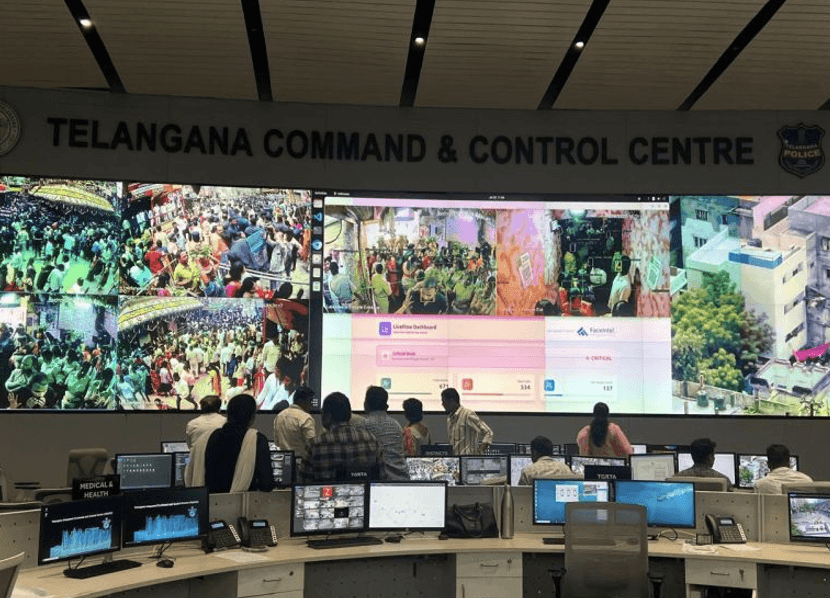
No Real-Time Crowd Density Awareness
Live camera feeds show visuals, but they do not provide an accurate, real-time understanding of crowd density or whether thresholds are approaching unsafe levels.
By the time congestion becomes obvious on screens, options for safe intervention are already limited.
Delayed Response Due to Manual Monitoring
Crowd monitoring still relies heavily on operators watching multiple screens and escalating issues manually. During long events, fatigue is inevitable and early warning signs are often missed.
Response depends on observation rather than system-driven alerts.
Difficulty Tracking Individuals in Dense Crowds
In high-density situations, identifying and tracking specific individuals such as suspects or missing persons is extremely difficult.
Once a person moves out of a single camera's view, continuity is lost and tracking across locations becomes slow and fragmented.
Limited Situational Awareness for Field Teams
On-ground officers often receive delayed or incomplete information. Without precise, location-specific inputs, responses tend to be reactive rather than preventive.
What Changes When Intelligence Is Applied on Top of Video
An intelligence layer operating above the existing camera infrastructure changes how surveillance is used during live events.
Instead of relying on video review, live feeds are continuously analysed to generate real-time operational signals that can be acted upon immediately.
Real-Time Footfall and Density Threshold Alerts
Footfall is measured continuously across critical zones. Density thresholds are defined in advance, and alerts are triggered automatically as crowd levels approach unsafe limits.
This enables early intervention regulating entry, opening alternate routes, and redirecting movement before congestion escalates.
Tracking Individuals Using Persistent Unique IDs
Each detected individual is assigned a unique, persistent ID, allowing movement to be tracked across cameras and locations.
This makes it possible to locate missing persons, follow suspects, and monitor individuals causing disturbance even within dense crowds.
Direct Alerts to On-Field Officers
Alerts are delivered in real time to teams on the ground, providing clear, location-specific information and enabling faster, more precise intervention.
What Changed on the Ground
The impact was not dramatic and that is precisely the point.
Crowd build-up was identified early. Movement was regulated before conditions became critical. Individuals were tracked without creating panic. Field teams acted calmly, with clarity. Most importantly, potential incidents were addressed before they escalated.
The Broader Lesson for Public Safety
Stampedes are not random events. They are failures of early awareness, coordination, and timing. When authorities have real-time visibility into crowd density, movement patterns, and individual behaviour and when this information reaches the right people at the right time many incidents can be prevented altogether.
From Reactive Control to Preventive Safety
Public safety at scale cannot depend on reacting after something goes wrong. Stampedes do not start suddenly. They build up quietly. The difference lies in whether those signals are seen and acted upon in time.

Written by
Akhil Gurram
Co-Founder & CTO, FaceIntel Technologies Pvt. Ltd.
December 18, 2025
15 min read
FaceIntel Discovery Pilot Program
Collaborate with FaceIntel to validate identity intelligence in live, production environments — built for scale and compliance.